



The 10-day demand letter for payment or the demand of payment letter is a formal written letter stating the exact amount of debt owed. Writing this letter is usually brought about when a debtor fails to settle an outstanding debt, a merchant doesn’t grant a refund, or any other instance involving unpaid financial obligation. Regardless of what causes it, such disputes might end up dragging along indefinitely.
Are you in a situation where the debtor is refusing to pay the owed money? If this is the case, then the right step is to write a 10-day demand letter for payment. But how exactly do you go about doing this? Here’s an overview of everything you need to know when writing the 10-day demand letter for payment.
How to Write and Send the 10-Day Demand Letter For Payment
When writing the 10-day demand letter for payment, there are a couple of steps you need to follow, including;
Step 1 – Begin With A Polite Intro
It’s always best you be professional and courteous when writing the 10-day demand letter for payment. It’s essential to observe this regardless of the backstory that has led to you writing the demand letter. After all, starting in a harsh and violent tone only worsens the matter rather than helping resolve the issue.
Step 2 – Outline The History Of Services
When writing this letter, make sure to include all the vital details about the owed amount and your past attempts to get the money. Make sure to give a detailed account of each incident and the desire for a solution. In addition, the dates must be included to prevent any confusion on this matter from coming up later in the future.
Note: Before you can take the case to court, you’re first required to show whether you had sent the demand letter. This is necessary as this letter acts as proof of requesting payment should the issue become a civil claim.
Across most of the jurisdictions, this is a requirement that needs to be met before the case is taken to court. Moreover, this letter provides the court with crucial facts if the case finds its way in court. Therefore, it helps you, the accuser, in planning your thoughts and developing a legal strategy. As you draft this letter, ensure it’s well-written and perfectly documented to show objectivity and toughness to your adversary.
Step 3 – Demand Payment And Due Date
This letter is referred as the “10-Day” for justifiable reasons as it states the payment should be made ten days from when the date when this letter has been sent, instead of date of receipt. The 10-days are standard and give the opposing party enough time to respond while still giving them much-needed pressure.
Step 4 – Prepare For Delivery
You must always send the 10-day demand letter for payment through certified mail. If you don’t, then there’s always a likelihood that the opposing party might refute getting the demand letter. Also, never send the demand for payment via text or email.
What to Include In The 10-Day Demand Letter
When writing the 10-day demand letter for payment, there are specific details that must always be included. Here’s an overview of the information that must be included at all times;
- Date debt was acquired: This is the date when the unpaid work was done.
- Details of the debt: Here, you should highlight details on the debt, such as the agreed amount, the nature of the agreement, and an explanation of the breach of the agreement.
- Party information: This should be the creditor’s personal details and the individual required to pay the debt.
- Date when the debt was improperly charged: If this dispute is about a charge for services that haven’t been delivered or any other inappropriate charge, state the date of this charge.
- Expectations for payment: This should be a definitive and clear explanation of the expectations by when the payment needs to be made.
- Details of previous attempts to settle the debt: You should include details such as invoices mailed, emails sent, and calls made.
- Signature: The signing of the demand letter by the creditor.
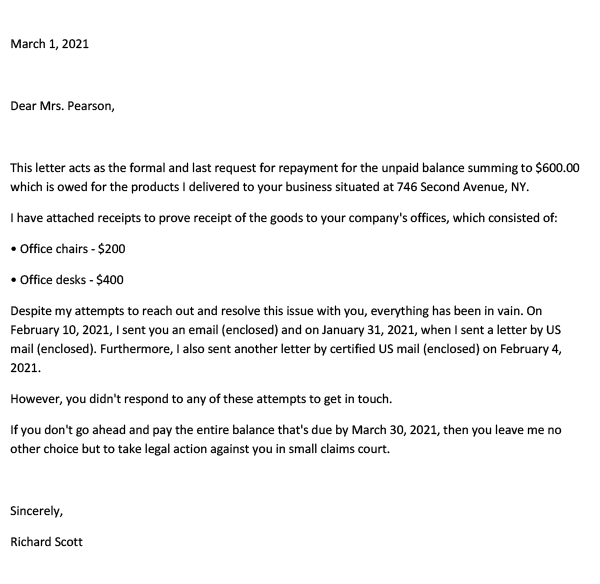
Sample 10-Day Demand Letter
March 1, 2021
Dear Mrs. Pearson,
This letter acts as the formal and last request for repayment for the unpaid balance summing to $600.00 which is owed for the products I delivered to your business situated at 746 Second Avenue, NY.
I have attached receipts to prove receipt of the goods to your company’s offices, which consisted of:
• Office chairs – $200
• Office desks – $400
Despite my attempts to reach out and resolve this issue with you, everything has been in vain. On February 10, 2021, I sent you an email (enclosed) and on January 31, 2021, when I sent a letter by US mail (enclosed). Furthermore, I also sent another letter by certified US mail (enclosed) on February 4, 2021.
However, you didn’t respond to any of these attempts to get in touch.
If you don’t go ahead and pay the entire balance that’s due by March 30, 2021, then you leave me no other choice but to take legal action against you in small claims court.
Sincerely,
Richard Scott
10-Day Demand Letter for Payment (Word Template)
Takeaway
It’s always best to resolve a dispute without litigation. Nonetheless, this can’t always be achieved and in such cases, writing the 10-day demand letter for payment becomes necessary. If you had no clue how to write this letter, this post has offered you the steps to follow when writing one. Therefore, you can go ahead and serve your adversary with one to ensure you get full payment for the due amount.