


Home » Breach of Contract Demand Letter

Breach of Contract Demand Letter

ads
Free Download This Template
Share

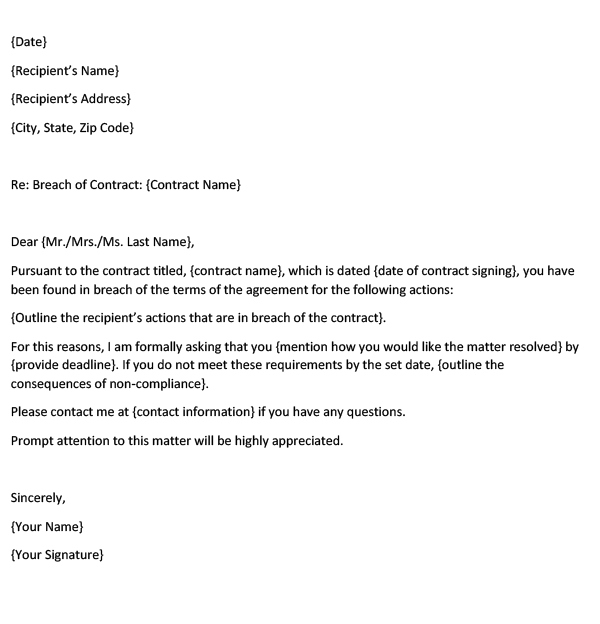
Breach of Contract Demand Letter

A breach of contract demand letter is a formal notice you send when the other party fails to perform as promised. The letter identifies the agreement, states what went wrong in factual terms, ties each failure to the contract, itemizes the money or performance now due, and sets a firm deadline to cure. In contract disputes, the goal of remedies is to place you in the position you would have occupied if the contract had been performed. Your letter should connect each claimed loss to the agreement and the specific breach so the recipient can verify every point quickly.

Quick Facts

  • Notice and Cure Matters. Many contracts require written notice and a defined cure period. Follow the clause precisely, including recipient names, addresses, and delivery methods listed in the agreement.
  • Mitigation Is Required. You must take reasonable steps to reduce losses after a breach. Courts do not award damages that you could have avoided with reasonable efforts.
  • Settlement Statements Are Limited in Court. Federal Rule of Evidence 408 restricts the use of settlement offers and negotiations to prove liability or amount, though courts may admit them for other purposes. Draft with care.
  • Damages for Goods Can Include Incidentals and Consequentials. Under UCC §2-715, buyers may recover incidental expenses and, when foreseeable, consequential losses tied to the breach.
  • Attorney’s Fees Are Not Automatic. The American Rule presumes each side pays its own lawyer unless a statute or contract shifts fees; some statutes carve out exceptions.

How to Write a Breach of Contract Demand Letter

Before drafting, gather the signed agreement, amendments, change orders, key emails, invoices, delivery receipts, and any project numbers your reader will use to match facts to proof. Write from the top of the page downward so the letter reads like a clear timeline with a precise ask at the end.

Letterhead, Date, and Recipient

Place your business name, address, phone, and email at the top, then add the date and the recipient’s full mailing address and title. Use the notice address stated in the contract. If more than one address is listed, send to each and keep proof of delivery.

Example

John Stamos
860 Washington St
New York, NY 10998

January 22, 2094

David Patrick Kelly
Contracts Manager
North River Studio, LLC
455 Lexington Avenue, Suite 900
New York, NY 10017

Reference Line That Anchors the Agreement

Place a concise “Re” line directly under the recipient block. Identify the contract title or number, the effective date, and the parties. Keeping it on one concise line makes it easy to scan and cite.

Example

Re Website Redesign Agreement WR-2094-22, effective May 1, 2094; Parties: John Stamos and North River Studio, LLC

One-Paragraph Contract Summary

State when the contract was signed and what it covers. If milestones, quantities, or service levels define performance, mention exact names or section numbers so the reader can check quickly.

Example

On May 1, 2094, John Stamos and North River Studio, LLC executed Agreement WR-2094-22 for a full redesign of the Highline Retail site with three milestones as defined in Sections 3.1 through 3.3.

Describe The Breach Precisely

Explain what failed and when. Tie each failure to the clause that governs performance. If deliverables were late or non-conforming, say how they fell short. If payment is overdue, name the invoice, amount, and due date. If the contract grants a right to cure, acknowledge it and move directly to your deadline.

Example

You failed to deliver Milestone 2 due July 15, 2094. The work sent on July 28, 2094 did not meet the cross-browser and page-speed requirements in Sections 3.2 and 3.3. Source files and administrator credentials required under Section 5.1 remain outstanding.

Itemize the Money and Losses

State the total due and break it into clear buckets in a single paragraph. Include past-due payments, cover costs paid to a replacement vendor, and documented incidental expenses. If your contract or state law supports interest, show the calculation through a stated date.

Example

As of today, the total due is $18,940. This includes Invoice 1022 past due of $9,700, cover costs paid to Replacement Dev Co. of $6,500, and quality-assurance and content-migration costs of $2,600, plus interest through October 23, 2094 of $140.

Define the Demand and What “Cure” Means

Give a firm deadline and spell out exactly what must happen by that date. If performance is still possible, name the remaining deliverables. If performance is no longer workable, focus on payment and return of materials, credentials, or equipment.

Example

Cure the breach by November 1, 2094 by paying $18,940 and delivering all project source files, theme assets, and administrator credentials for the staging and production environments.

State How to Send Payment and Deliverables

List acceptable payment methods and delivery channels taken from the contract’s payment and notice provisions. Provide a physical address for checks and wired-funds details when needed. Give one email address for confirming delivery.

Example

Send payment by ACH or cashier’s check to John Stamos, 860 Washington St, New York, NY 10998. Email delivery confirmations to [email protected].

Reserve All Rights and Name Potential Remedies

Close with a sentence that preserves your rights if the breach is not cured. Remedies may include termination, damages, interest, recovery of cover costs, and attorney’s fees where a statute or a fee-shifting clause permits them.

Example

If you do not cure by November 1, 2094, I will pursue all remedies available under Agreement WR-2094-22 and applicable law, including termination for cause, damages, interest, recovery of cover costs, and attorney’s fees where permitted. Nothing in this letter waives any right or remedy.

Note Enclosures and Sign

If you enclose documents, point to them in the body so the reader can verify each statement. Sign the letter with your printed name and title. If you act for a company, sign in that capacity.

Example

Enclosures: Agreement WR-2094-22 and Amendment 1; Invoice 1022 (June 30, 2094);
Email chain dated July 28, 2094; QA report dated August 2, 2094.

John Stamos
Managing Member, Stamos Digital LLC

Keep the Tone Professional and Protect Settlement Communications

Stick to facts and keep language measured. Consider labeling the letter “For Settlement Purposes Only.” Federal Rule of Evidence 408 limits the use of settlement communications to prove liability or amount, though a court may admit them for other purposes. Write as if a judge will read it.

Pro Tip:

When a notice clause lists more than one address or method, send to all listed recipients and methods and keep each proof of delivery.

Sample Breach of Contract Demand Letter

Example

John Stamos
860 Washington St
New York, NY 10998

October 23, 2094

Kevin Doyle
Contracts Manager
North River Studio, LLC
455 Lexington Avenue, Suite 900
New York, NY 10017

Re Website Redesign Agreement WR-2094-22, effective May 1, 2094; Parties: John Stamos and North River Studio, LLC

Dear Mr. Doyle,

On May 1, 2094, John Stamos and North River Studio, LLC entered into the Website Redesign Agreement WR-2094-22 for a full redesign of the Highline Retail site with three milestones. You failed to deliver Milestone 2 by July 15, 2094, and the work sent on July 28, 2094 did not meet the cross-browser and page-speed requirements in Sections 3.2 and 3.3. Source files and administrator credentials required under Section 5.1 remain outstanding. These breaches have caused direct losses.

As of today, the total due is $18,940. This amount includes Invoice 1022 past due of $9,700, cover costs paid to Replacement Dev Co. of $6,500, and direct costs for quality assurance and content migration of $2,600, plus interest through October 23, 2094 of $140.

Cure the breach by November 1, 2094 by paying $18,940 and delivering all project source files, theme assets, and administrator credentials for the staging and production environments. Send payment by ACH or cashier’s check to John Stamos at 860 Washington St, New York, NY 10998. Email delivery confirmations to [email protected].

If you do not cure by the deadline, I will pursue all remedies available, including termination for cause, damages, interest, recovery of cover costs, and attorney’s fees where permitted. Nothing in this letter waives any right or remedy.

Please respond in writing by October 28, 2094.

Sincerely,
John Stamos

How to Serve Your Breach of Contract Demand

Start with the contract’s notice clause. If it specifies certified mail, courier, multiple recipients, or exact timelines, follow those instructions exactly. When the agreement is silent, use a reliable, trackable method, keep records, and send a courtesy email copy for speed. The five-step sequence below expands common practice.

Detail the Original Contract Information

Identify the contract title or number, the effective date, the parties, and any amendments. This lets the recipient match your claims to the correct agreement immediately.

Describe the Breach in Verifiable Terms

Set out what failed and when, tied to clauses, milestones, or invoice numbers. Avoid opinions. Give dates that match documents you can produce.

State Cure Rights or Settlement Terms

If the agreement grants a right to cure, restate it and set a firm deadline. If you propose a settlement, write factually because Rule 408 limits how those communications can be used in court.

Deliver the Letter and Keep Proof

Use the required methods in the contract. If none are listed, send by a trackable carrier such as certified mail or reputable courier to the business address, then email a copy. Save tracking pages, receipts, and screenshots.

If the Deadline Passes, Choose the Next Forum

If there is no cure, consider the forum your contract names. That may be mediation, arbitration, small claims, or a civil court. Preserve delivery proofs, the contract, amendments, and your mitigation records.

Important:

Keep a simple log with dates, actions taken, and the documents that prove each step. Pair that log with your emails, quotes, invoices, receipts, photos, and tracking pages. This combination shows that your mitigation was reasonable and well documented.

  • Damages Basics. Expectation damages aim to put you where full performance would have put you. For sales of goods, UCC Part 7 outlines buyer remedies, including incidental and consequential damages under §2-715.
  • Settlement Communications. Rule 408 restricts using settlement statements to prove liability or amount. Label settlement discussions appropriately and write factually.
  • Attorney’s Fees. The American Rule presumes each party pays its own attorney unless a statute or contract provides otherwise. Examples include fee-shifting statutes and specific fee provisions in agreements.

FAQs

Do I need to send a demand letter before I file a lawsuit?

Often you do. Many contracts require written notice and a cure period before you can terminate or sue. Even when the contract is silent, sending a demand letter is a practical first step because it frames the facts, documents your mitigation efforts, and creates a record that you acted reasonably before litigation. Follow any notice instructions and keep delivery proof.

How long should I give to cure the breach?

Use the cure period stated in your contract. If the agreement does not set one, choose a reasonable window that matches the work at issue and industry timing. A short nonpayment cure may be a few days, while a performance cure may need more time. Explain why the window is reasonable and link it to dates in the contract.

What should I attach to strengthen the letter?

Attach only what proves your statements. Common enclosures include the signed contract and amendments, relevant change orders, dated emails confirming deadlines or approvals, invoices, delivery receipts, and photos or reports for nonconforming work. Cross-reference each attachment in the body so the reviewer can verify each fact fast.

Can I recover attorney’s fees if I win?

Courts apply the American Rule in most civil cases, which means each party pays its own lawyer. You may recover fees only if a statute or your contract authorizes it, or in narrow bad-faith scenarios recognized by case law. Read your agreement for a fee-shifting clause and do not assume fees are automatic.

Do I have to mitigate my damages?

Yes. You must take reasonable steps to reduce loss after the breach, such as hiring a replacement vendor when performance stops. Keep dated records of decisions and costs, because courts often disallow losses that could have been avoided with reasonable efforts.