


Home » Unpaid Wages Demand Letter

Unpaid Wages Demand Letter

ads
Free Download This Template
Share

Unpaid Wages Demand Letter

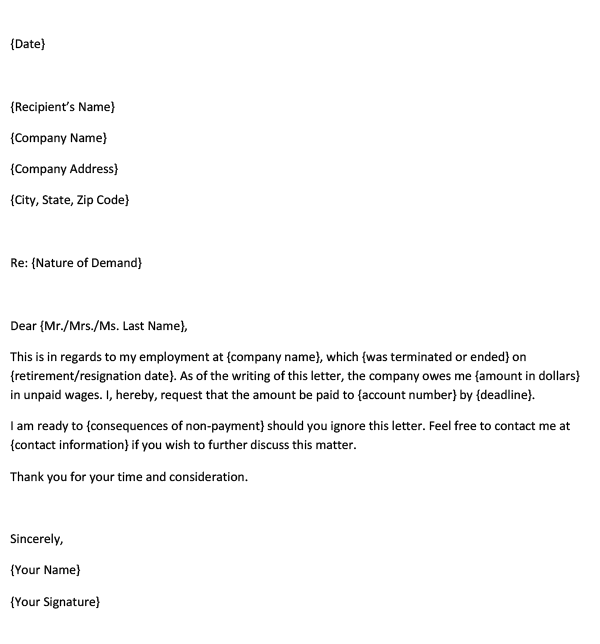
An unpaid wages demand letter is a formal, written request you send to an employer to collect wages you earned but did not receive. It documents your employment details, the dates worked, what remains due, how you calculated the amount, and a deadline for payment. A clear letter often prompts quick resolution because it shows the facts in one place and previews what will happen next if payment is not made, such as filing a wage claim with a state labor agency or the U.S. Department of Labor’s Wage and Hour Division (WHD). This description follows your Writing and Tone Guide for structure, clarity, and reader-friendly detail.

Quick Facts

  • Federal law lets workers recover back wages and an equal amount in liquidated damages for minimum wage or overtime violations. The statute of limitations is two years, or three for willful violations.
  • It is illegal for an employer to retaliate against you for asserting wage rights or contacting WHD.
  • You can file unpaid wage claims with WHD or your state labor agency, such as California’s Labor Commissioner or the New York Department of Labor.

How to Write an Unpaid Wages Demand Letter

Start by opening your template and move through the page from top to bottom. Aim for clean facts, specific dates, and simple math. Each step below includes a short example so you can see the tone and level of detail to use. Keep examples in paragraph form rather than bullets.

Add the date

Place the date you are sending the letter at the top. Using a date anchors your later deadline.

Example

November 9, 2094.

List the employer contact and mailing address

Address the letter to the person who can resolve payroll issues, such as the payroll manager or HR lead. Include the company name and a complete U.S. mailing address.

Example

Candace Cameron Bure, Payroll Manager, North River Catering, LLC, 455 Lexington Avenue, Suite 900, New York, NY 10017.

Write a clear subject line

In bold if your template supports it, add a brief “Re:” line that summarizes the purpose. Mention the position and covered dates.

Example

Re: Demand for unpaid wages for Server during May 1, 2094 to July 15, 2094.

Use a professional salutation

Choose “Dear Mr./Ms. [Last Name],” or “Dear Payroll Department,” if you do not have a name.

Example

Dear Ms. Bure,

Introduce who you are and the period worked

State your role, when you worked, and that certain wages remain due. Cite the legal basis in plain language without legal jargon.

Example

I worked for North River Catering as a server from May 1, 2094 to July 15, 2094. Wages for the periods listed below remain unpaid. Under New York wage law and the federal Fair Labor Standards Act, wages must be paid in full and on time.

You may reference federal law in general terms. If you mention specific rights like overtime time-and-a-half or back wages, those come from the FLSA and WHD guidance.

Itemize what is owed and show the math

In one or two paragraphs, list categories such as regular wages, overtime, short final paycheck, reimbursable expenses, and accrued but payable vacation or PTO if covered by law or policy. Keep the math transparent.

Example

Unpaid regular wages total $960.00 for 40 hours at $24.00 per hour. Unpaid overtime totals $432.00 for 12 hours at $36.00 per hour. My final paycheck is short by $318.00. Reimbursable expenses are $85.00 for uniform cleaning and travel between sites. The total due as of today is $1,795.00.

If vacation or PTO is payable under your state law or the employer’s written policy, include that figure. In New York and California, you typically recover unpaid wages and illegal deductions through state claim processes if the employer does not resolve the demand.

Set a firm payment deadline and how to pay

Give a realistic window, usually 7 to 14 days from the date of the letter. Provide specific payment instructions and a mailing address.

Example

Please pay the total due by November 19, 2094. Payment may be made by ACH or check to 860 Washington St, New York, NY 10098.

Invite a records-based response if they disagree

If the employer disputes the amount, ask for an itemized wage statement and supporting records by an earlier response date. This keeps the conversation focused on documents, not opinions.

Example

If you disagree with any item, send an itemized wage statement and supporting records by November 13, 2094 so the matter can be reviewed.

State what you will do if the deadline passes

Tell the employer you will file a wage claim with the appropriate agency and consider civil remedies available under law, including liquidated damages, penalties, interest, and attorney’s fees where allowed. Keep the tone factual.

WHD explains that workers can recover back wages and an equal amount in liquidated damages for minimum wage or overtime violations. States such as California and New York also run their own wage claim processes.

Example

If I do not receive full payment by November 19, 2094, I will file a wage claim with the New York State Department of Labor and may pursue civil remedies, including liquidated damages, penalties, interest, and attorney’s fees where permitted.

Remind them that retaliation is unlawful

Close this section with a brief line that you expect a professional response and that the law prohibits retaliation for asserting wage rights or contacting WHD.

Example

Retaliation for asserting wage rights is prohibited by New York law and the Fair Labor Standards Act.

Close and add your signature block

Use “Sincerely,” then sign above your printed name. Add a phone number and email so payroll can reach you quickly.

Example

Sincerely,
Jodie Sweetin
(212) 555-0142
[email protected]

Attach copies of key records

Do not send originals. Attach copies of time sheets, schedules, pay stubs, tip records, expense receipts, emails confirming rates, and any policies about PTO or reimbursements. If you later file a claim, WHD and state agencies will ask for the same types of proof, so gathering them now keeps your case organized.

Sample Unpaid Wages Demand Letter

Example

November 9, 2094

Richard Beymer
North River Catering, LLC
455 Lexington Avenue, Suite 900
New York, NY 10017

Re: Demand for unpaid wages for Server during May 1, 2094 to July 15, 2094

Dear Mr. Beymer,

I worked for North River Catering as a server from May 1, 2094 to July 15, 2094. Wages remain unpaid for my last pay period and overtime worked in June. Under New York wage law and the Fair Labor Standards Act, wages must be paid in full and on time.

Unpaid regular wages total $1,008.00 for 42 hours at $24.00 per hour. Unpaid overtime totals $360.00 for 10 hours at $36.00 per hour. My final paycheck is short by $250.00. Reimbursable expenses are $74.00 for uniform cleaning and local travel. The total due as of today is $1,692.00.

Please pay the total due by November 19, 2094. Payment may be made by ACH or check to 860 Washington St, New York, NY 10098. If you disagree with any item, send an itemized wage statement and supporting records by November 13, 2094.

If this is not resolved by the deadline, I will file a wage claim with the New York State Department of Labor and may pursue civil remedies that can include liquidated damages, penalties, interest, and attorney’s fees where allowed. Retaliation for asserting wage rights is prohibited by New York law and the FLSA.

Sincerely,
Jodie Sweetin
(212) 555-0142
[email protected]

Under the FLSA, workers can recover unpaid minimum wage and overtime, plus an equal amount in liquidated damages. Federal claims are generally limited to two years, or three if the violation was willful. Stating a clear deadline in your demand letter does not change these legal time limits, so do not wait to act if the employer stalls.

When to Escalate to a Government Agency

If the employer does not pay by your deadline or refuses to share records, escalate. You can contact WHD to file a complaint or submit a claim to your state agency. California workers can file online, by email, mail, or in person with the Labor Commissioner. New York workers can file a Labor Standards wage theft claim and attach copies of pay stubs, time records, and other proof.

What Evidence to Gather

Keep a neat set of copies that show your hours, rates, and expenses. Typical records include schedules, timesheets, tip logs, text or email confirmations of rates, expense receipts, and prior pay stubs. WHD recommends gathering employer contact details and basic job information when you file a complaint, which mirrors what you include in your demand letter.

Mistakes to Avoid

Avoid vague totals without math, skipping dates, or leaving out a payment deadline. Do not send original receipts or the only copy of a timesheet. Do not wait so long that legal deadlines become a risk. If you feel intimidated, remember that retaliation is prohibited and you can speak with WHD or a state labor agency confidentially.

FAQs

Do I have to send a demand letter before filing a wage claim?

 No federal rule requires a demand letter, but many workers resolve disputes quickly after sending one because the employer sees the hours, rates, and totals in one place. If payment does not arrive by your deadline, move to a formal claim with WHD or your state labor agency so time does not run out under the statute of limitations.

What should I write if I was paid in cash and never received a pay stub?

Describe your schedule, the rate you were promised, and the dates worked. Attach what you have, such as texts confirming shifts, photos of posted schedules, tip books, or bank deposits that match cash payments. WHD and state agencies can investigate even when employers do not keep proper records, and your notes still matter.

How much time should I give for the payment deadline?

Seven to fourteen days is common. Choose a date that gives payroll enough time to cut a check while keeping momentum. The deadline in your letter does not change legal filing deadlines. If the employer asks for more time and you agree, document that in writing and set a new date.

Can my employer punish me for sending this letter or filing a claim?

 No. The FLSA prohibits retaliation for asking about pay, asserting wage rights, or cooperating with an investigation. Retaliation can include termination, demotion, schedule cuts, or threats. If you face pushback after sending the letter, contact WHD or your state agency and keep copies of any messages or schedule changes.

If I worked in California or New York, should I send the letter or file a claim first?

You can send the letter first to try to resolve the matter. If that does not work, file with your state agency. California’s Labor Commissioner and the New York Department of Labor both provide online instructions and forms to collect unpaid wages and illegal deductions.