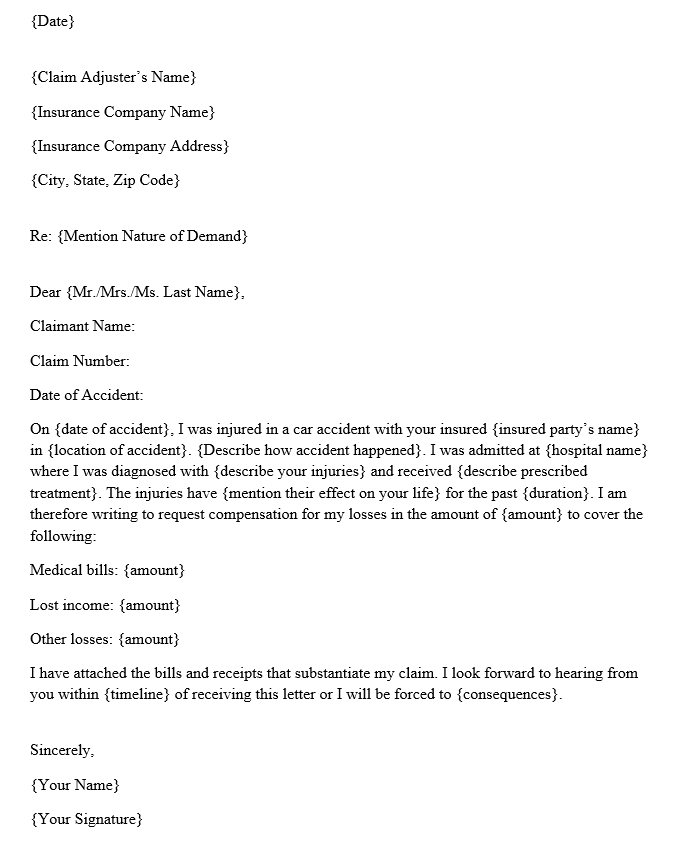



A car accident demand letter is a formal settlement request you send to the at-fault driver’s insurer after a crash. It sets out the facts of the collision, explains why their insured is liable, details your injuries and treatment, documents economic losses such as medical bills and lost wages, and requests a specific dollar amount to settle your bodily-injury and property-damage claims. The letter also gives the adjuster a reasonable deadline to respond and states that the communication is for settlement purposes only under evidence rules. A well-built demand package reduces guesswork for the adjuster, keeps negotiations professional, and positions you to resolve the claim without filing a lawsuit.
Quick Facts
- Most states set lawsuit filing deadlines for injury claims that range from one to six years. Demand early enough to preserve your rights.
- Settlement discussions are generally not admissible at trial under Federal Rule of Evidence 408. Include a brief statement that your letter is for settlement purposes only.
- Claim-handling timelines vary by state. As one example, California regulations require insurers to accept or deny a claim within 40 days of receiving proof of claim.
How to Write a Car Accident Demand Letter
Before you write, gather three things that anchor negotiations. First, clear facts that show fault, such as a police report or a witness statement. Second, a coherent treatment story from the first medical visit through your current condition. Third, proof of losses in dollars, including bills, wage documentation, and receipts. Adjusters read hundreds of letters, and they move fastest when you present facts, a logical injury narrative, and verifiable numbers.
Add the Date and the Recipient Block
Place the date at the top, then the adjuster’s name, insurer, mailing address, and claim number if assigned. Accuracy matters since insurers often scan correspondence into claim files by these fields. If you do not have an adjuster’s name yet, address the letter to the claims department and include the policy number.
Example
October 10, 2094
Cathy Belton, Claims Adjuster
Evergreen Mutual Insurance Company
1200 Park Avenue
New York, NY 10001
Claim No. EM-2094-4472
Write a precise “Re” line
A short reference line helps the adjuster identify the claim at a glance. Include the crash date, location, insured’s name, and policy number if available.
Example
Re: Collision on September 12, 2094 at 10th Avenue and West 14th Street, New York, NY; Insured: John Stamos; Policy No. JS-7782-94
Open with a courteous greeting
Use a professional salutation. Keep the tone firm and factual from the first sentence onward.
Example
Dear Ms. Belton,
Explain liability and summarize how the crash occurred
In one or two paragraphs, describe the incident in time order. Name intersections, traffic signals, weather, and what each driver was doing. Identify evidence that supports fault, such as the police report or photographs. Avoid opinion language and stick to facts.
Example
I am writing regarding the collision on September 12, 2094, at the intersection of 10th Avenue and West 14th Street in New York City. Your insured, John Stamos, proceeded through a steady red signal and struck the driver-side of my vehicle. The police report, scene photographs, and an independent witness confirm fault.
Describe injuries and treatment
Transition to your medical story. Start with same-day care, then list specialists, diagnostics, therapy, and current status. Name clinics and dates. Connect symptoms to functional limits at work and home. Do not exaggerate. If you had prior conditions, briefly distinguish them from new injuries.
Example
I was evaluated in the emergency department the same day and continued care with Midtown Orthopaedics and Hudson Physical Therapy for a cervical strain and a left shoulder sprain. Treatment began on September 13, 2094, and continued through September 30, 2094. Records and itemized bills are enclosed.
Itemize economic losses in sentences, not tables
Adjusters need numbers and documentation. State totals for medical expenses, lost wages, property damage, and out-of-pocket costs. Identify the employer for wage loss and the dates missed. If you used paid leave, note the hours and rate. If you had towing or rental expenses, state the amounts and keep receipts.
Example
Medical expenses total $17,980. Lost wages equal $5,760 based on verification from Highline Fabrication for missed work from September 13 through September 27, 2094. Property damage and towing were $3,050. Out-of-pocket expenses, including prescriptions and transport to medical appointments, were $410.
Address non-economic losses with credible reasoning
Briefly explain pain, limitations, and disruption to daily life. Use specifics a stranger can picture, such as sleep disruption, difficulty caring for a child, or time missed from a planned event. Avoid formulas as if they were rules. Multipliers and per-diem methods can be used to estimate value internally, but there is no universal formula that binds an insurer or a jury.
Example
For three weeks I could not lift my seven-year-old, and I was unable to complete scheduled overtime in the fabrication shop due to shoulder pain. I continue home exercises prescribed by my therapist.
State a specific settlement demand and the basis for the number
Give one number that resolves all claims arising from the crash. Explain that the amount reflects medical care, wage loss, property loss, and the impact on daily life. When policy limits might cap the claim, you can request confirmation of limits. If your injuries are still evolving, say that you reserve the right to supplement.
Example
Considering the documented losses, the recovery period, and the ongoing symptoms, I demand $80,000 to settle all claims from this incident. Please confirm the bodily-injury limits available under policy JS-7782-94.
Set a reasonable response deadline and give mailing instructions
Most states regulate claim handling but do not guarantee a fast resolution. A reasonable response window for a first demand is often 20 to 30 calendar days, which keeps the claim moving without sounding aggressive. California’s regulations, for example, require insurers to accept or deny a claim within 40 days of receiving proof of claim, while New York rules require prompt acknowledgment of claims. Your deadline is not a law, but it can prompt action.
Example
Please respond in writing within 20 calendar days of the date of this letter. Send correspondence to Sherilyn Fenn at 860 Washington St, New York, NY 10998.
Add a settlement-only statement
Include a short line that settlement communications are not admissible to prove liability or damages. Evidence rules protect good-faith negotiations and encourage resolution outside court.
Example
This communication is for settlement purposes only under Federal Rule of Evidence 408 and comparable state rules.
Close, sign, and organize your enclosures
Close respectfully, sign the letter, and list what you are enclosing. Typical enclosures include medical records and bills, wage verification, repair invoices, photographs, and the police report. Put documents in a clean, logical order that mirrors your letter so the adjuster can review quickly.
Example
Sincerely,
Sherilyn Fenn
Enclosures: medical records and bills; wage verification letter; photographs; police report; repair invoice and towing receipt
Sample Car Accident Demand Letter
Example
November 4, 2094
Kimmy Robertson, Claims Adjuster
Harbor State Insurance Company
700 S Flower St, Suite 2100
Los Angeles, CA 90017
Re: Collision on October 6, 2094 at Sunset Boulevard and N Crescent Heights Boulevard, West Hollywood, CA; Claim No. HS-2094-1182; Insured: Kyle MacLachlan; Policy No. KM-4421-94
Dear Ms. Robertson,
I am writing regarding the rear-end collision on October 6, 2094, while I was stopped at a red signal on Sunset Boulevard at North Crescent Heights Boulevard in West Hollywood. Your insured, Kyle MacLachlan, failed to stop in time and struck my vehicle from behind. The Los Angeles Police Department traffic report and scene photographs confirm fault. An independent witness, Mädchen Amick, also provided a statement describing that your insured looked down moments before impact.
That evening I was evaluated at Cedars-Sinai Medical Center for head and neck pain and was diagnosed with a concussion without loss of consciousness and a cervical sprain. Follow-up care included visits with Dr. Warren Frost and a course of physical therapy at Fairfax Rehab from October 8, 2094 through November 2, 2094. Symptoms included daily headaches, limited neck rotation, and difficulty driving for more than thirty minutes. I continue a home exercise program and have a follow-up appointment scheduled to monitor recovery.
My economic losses are documented. Medical expenses total $24,630. I missed fourteen workdays from Silver Lake Studios and lost $8,400 in wages, verified by my supervisor’s letter. Property damage and rental expenses were $4,280. Out-of-pocket costs for prescriptions, a cervical collar, and ride services to therapy appointments were $518.
The collision disrupted work and home life. For three weeks I could not drive my son to school, and I slept in a recliner to manage neck pain. I postponed a planned on-location shoot and passed on overtime opportunities that required prolonged driving.
Considering the strength of liability, the treatment course, the documented losses, and the effect on daily activities, I demand $125,000 to settle all claims arising from this incident. Please confirm the bodily-injury limits available under the policy and advise if additional records are needed.
Please respond in writing within 25 calendar days of the date of this letter. Send correspondence to Lara Flynn Boyle at 2211 Sunset Plaza Drive, Los Angeles, CA 90069.
This communication is for settlement purposes only under Federal Rule of Evidence 408 and comparable state rules.
Sincerely,
Lara Flynn Boyle
Enclosures: medical records and bills, wage verification, photographs, police report, repair estimate, rental receipts
Evidence and Enclosures to Consider
Insurers evaluate facts, liability, and damages. Include documents that prove each point. For liability, a police report, traffic-camera stills, or eyewitness statements strengthen your position. For injuries, use certified medical records and itemized bills rather than portal screenshots. For wage loss, request a supervisor letter on letterhead that lists your job title, hourly rate or salary, dates missed, and whether time was unpaid or deducted from PTO. Add receipts for medications, braces, rideshares to therapy, parking, and tolls. Your packet should enable the adjuster to verify each dollar without calling you for clarification.
How Insurers Evaluate Your Demand
Adjusters look at liability strength, causation, injury severity, treatment duration and type, medical bill reasonableness, wage proof, and any future care. They also consider state law on comparative negligence and the policy limits available. Many states reduce compensation if you share fault, and a few bar recovery if you were at or above a certain percentage of fault.
Choosing a Demand Amount Responsibly
Online articles mention multipliers or per-diem methods to estimate non-economic loss, but these are negotiation tools, not binding formulas. Your demand should reflect the facts, your documented losses, and how the injury changed your daily life. An aggressive opening can be strategic in severe cases, while a moderate number can speed resolution in minor injuries. There is no one right number, and insurers will not apply a universal formula.
When to Send and How to Deliver
Send your demand after you complete treatment or reach maximum medical improvement so your letter captures the full picture. If you must demand earlier due to a looming statute of limitations, note that you will supplement with updated records. Mail by certified mail with tracking, upload through the claim portal if offered, and keep a complete copy of everything you send. State law sets lawsuit deadlines, so calendar yours and avoid waiting until the last month.
FAQs
If you are still in active treatment, waiting often leads to a stronger demand because you can present complete records and a stable prognosis. You can send an interim letter if the statute of limitations is approaching, but state clearly that you will supplement and that your current amount reflects information available today. Filing deadlines are set by each state, so do not let treatment delays put your legal rights at risk.
In many states, your settlement is reduced by your percentage of fault under comparative negligence. Some states use modified rules that bar recovery if you are 50 or 51 percent at fault, while a few still follow contributory negligence which can bar recovery if you were even slightly at fault. Your letter should still present liability clearly with evidence, because strong liability reasoning reduces fault arguments.
No. Multipliers and per-diem rates are negotiation devices, not binding formulas. Adjusters will consider injury severity, treatment type, total medical costs, recovery time, and credibility of your account of daily impact. Use specifics rather than generic adjectives, and support your statements with medical notes when possible.
Your deadline encourages movement, but statutory timelines control the insurer’s duties and vary by state. As one example, California’s fair-claims regulations require insurers to accept or deny a claim within 40 days after receiving proof of claim. In New York, insurers must promptly acknowledge claims and start investigating, often within about 15 business days. Check your state’s rules and keep everything in writing.